Software
Community models
Part of our research contributes to the community models that carry climate and environmental science:
NEMO
OPERA contributes to improving the representation of uncertainties and introducing ML components within NEMO, the european ocean / sea-ice modelling framework.

WRF-Chem-Polar
OPERA co-leads developement of a regional chemistry-climate model based on WRF-Chem, with enhancements for the polar regions, developed at IGE and LATMOS in France.
LMDZ
OPERA contributes to the development of empirical run-time bias-corrections in LMDZ, including ML-based implementations, and focuses on regional-scale applications.

GEOS-Chem
OPERA contributes to improving the representation of atmospheric microplastics in the GEOS-Chem global atmospheric chemistry model
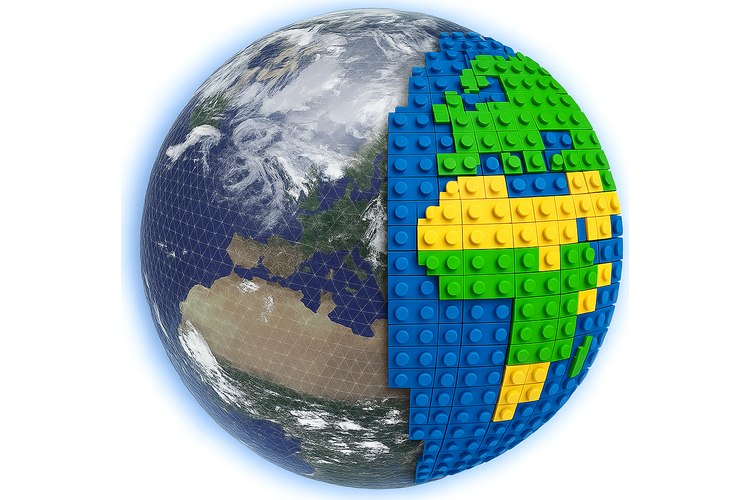
legoESM
OPERA contributes to legoESM, a fully differentiable Earth System Model in JAX — atmosphere, ocean, land, sea ice and lakes, coupled through one interface, with end-to-end gradients.

ODINN.jl
OPERA contributes to ODINN.jl, open-source glacier evolution modelling with neural differential equations — physics-informed machine learning in Julia.
OPERA software
Our own open-source tools, developed in the open in the IGE-OPERA GitHub organisation:
JaxParrow
Cyclogeostrophic surface currents computed with a minimisation-based approach, in JAX.
eophis
Couple Python scripts and tools into Fortran Earth system models through the OASIS3-MCT coupler.
Aronnax
Python wrapper for the ocean general circulation model NEMO v5.0.1 — drive the Fortran time loop and exchange model variables from Python.
More on our GitHub
- swot-omip — leveraging SWOT ocean data to assess ocean circulation models
- ocean-sea-ice-emulators-living-review — a living review of deep emulators for ocean and sea-ice modelling and forecasting